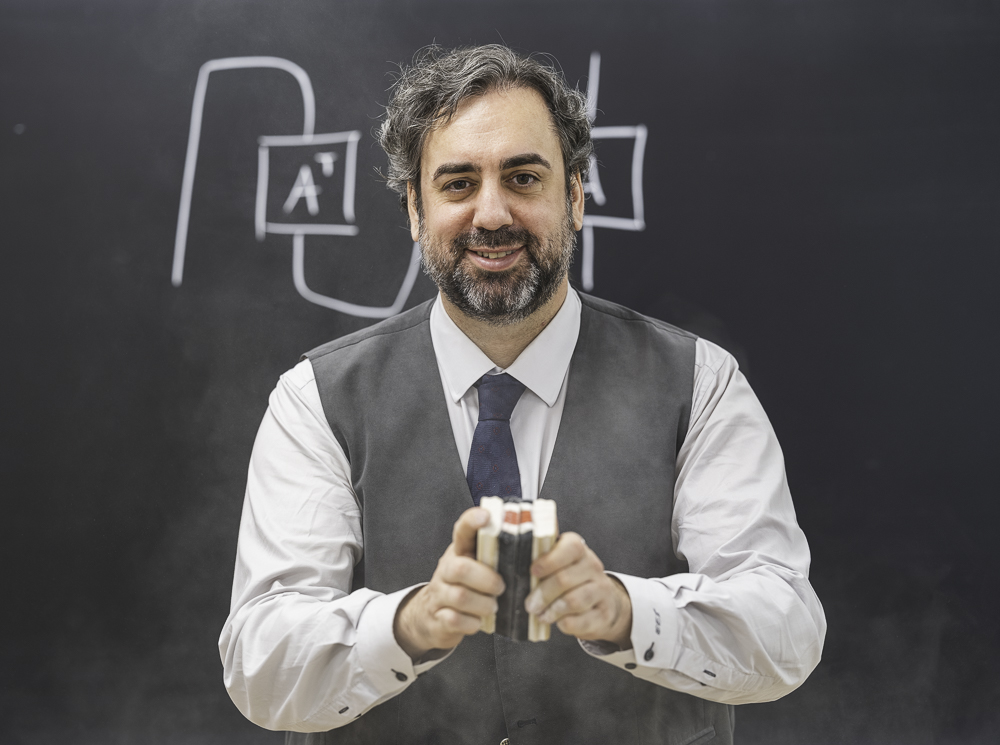
Jacob Biamonte
ÉTS Montréal, Université du Québec
From quantum computation to complex quantum networks
My research has been guided by a long-running question: what makes computation different in quantum systems? I first pursued this question through group-algebraic methods, tensor networks and computational complexity theory. These tools were powerful for exact and structural questions, yet less natural for studying average-case and ensemble behavior. They also offered less guidance about which large-scale models might reveal emergent properties of quantum information-processing systems.
During graduate school, workshops and seminars in network science opened a different perspective. I was struck by how seemingly simple patterns of connection can organize the behavior of systems that otherwise appear unrelated. I began to wonder whether network structure could expose the limits of reductionist descriptions of quantum systems—whether a complex network of quantum interactions carries explanatory power that is not visible from the components in isolation.
In 2012 I joined the ISI Foundation in Torino. I studied network science and, with collaborators, began building connections between network theory and quantum information. We related the long-time behavior of quantum walks to node degree and recast community detection in terms of quantum transport and distinguishability. We developed chiral quantum walks, showing how topology and broken time-reversal symmetry can direct, enhance, or suppress transport, and later helped demonstrate controlled time-reversal asymmetry and near-perfect transport experimentally on a three-qubit NMR quantum processor. In the other direction, we used ideas from quantum statistical mechanics to define entropies and distances for comparing classical networks. These results showed that network structure is not merely a diagram of a quantum system: it can act as an organizing and control principle for quantum information flow.
Together, this work helped establish a two-way exchange. Network science provides a language for collective quantum behavior, while quantum information—most concretely through our spectral-entropy framework—provides entropy, divergence, and distance measures for comparing, clustering, and inferring classical networks. This broader interface had important precedents in Bianconi and Barabási’s statistical-mechanical treatment of complex networks [1], Acín, Cirac, and Lewenstein’s entanglement-percolation framework [2], and the subsequent theory of quantum random networks developed by Perseguers and collaborators [3]. We brought these strands together in the 2019 review Complex Networks from Classical to Quantum, which surveyed the emerging field and outlined a broader research program at the intersection of network science and quantum information.
References:
[1] Bose–Einstein Condensation in Complex Networks
G. Bianconi and A.-L. Barabási.
Physical Review Letters 86, 5632–5635 (2001).
https://doi.org/10.1103/PhysRevLett.86.5632
[2] Entanglement Percolation in Quantum Networks
A. Acín, J. I. Cirac, and M. Lewenstein.
Nature Physics 3, 256–259 (2007).
https://doi.org/10.1038/nphys549
[3] Quantum Random Networks
S. Perseguers, M. Lewenstein, A. Acín, and J. I. Cirac.
Nature Physics 6, 539–543 (2010).
https://doi.org/10.1038/nphys1665
The statistical perspective I learned through network science also shaped my later work on quantum algorithms. By studying model statistics across density-ordered ensembles of random satisfiability problems, we identified reachability deficits in the Quantum Approximate Optimization Algorithm: even in the absence of barren plateaus, fixed-depth circuits can fail because target states lie outside the model family’s reachable state space, rather than because the optimizer has failed. This helped shift the field’s understanding of variational-algorithm trainability beyond optimization landscapes alone toward the structural and statistical limits of entire model families. Our subsequent work developed analytic results on parameter concentration and training saturation [Phys. Rev. Lett. 124, 090504 (2020); Phys. Rev. A 104, L010401 and L030401 (2021)].
Selected publications
- Degree Distribution in Quantum Walks on Complex Networks
- M. Faccin, T. Johnson, J. Biamonte, S. Kais, and P. Migdał.
- Physical Review X 3, 041007 (2013).
- https://doi.org/10.1103/PhysRevX.3.041007
- Community Detection in Quantum Complex Networks
- M. Faccin, P. Migdał, T. H. Johnson, V. Bergholm, and J. D. Biamonte.
- Physical Review X 4, 041012 (2014).
- https://doi.org/10.1103/PhysRevX.4.041012
- Quantum Transport Enhancement by Time-Reversal Symmetry Breaking
- Z. Zimborás, M. Faccin, Z. Kádár, J. D. Whitfield, B. P. Lanyon, and J. Biamonte.
- Scientific Reports 3, 2361 (2013).
- https://doi.org/10.1038/srep02361
- Chiral Quantum Walks
- D. Lu, J. D. Biamonte, J. Li, H. Li, T. H. Johnson, V. Bergholm, M. Faccin, Z. Zimborás, R. Laflamme, J. Baugh, and S. Lloyd.
- Physical Review A 93, 042302 (2016).
- https://doi.org/10.1103/PhysRevA.93.042302
- Spectral Entropies as Information-Theoretic Tools for Complex Network Comparison
- M. De Domenico and J. Biamonte.
- Physical Review X 6, 041062 (2016).
- https://doi.org/10.1103/PhysRevX.6.041062
Quantum Techniques in Stochastic Mechanics
J. C. Baez and J. Biamonte.
World Scientific (2017).
https://doi.org/10.1142/10623
- Complex Networks from Classical to Quantum
- J. Biamonte, M. Faccin, and M. De Domenico.
- Communications Physics 2, 53 (2019); Editors’ Selection—anniversary collection.
- https://doi.org/10.1038/s42005-019-0152-6